Alternative Risk Premia: Capturing Market Inefficiencies Beyond Traditional Investments
Understanding Alternative Risk Premia
Alternative Risk Premia (ARP) strategies aim to capture returns from persistent market inefficiencies and structural biases across asset classes. Unlike traditional investments that rely primarily on market beta exposure, alternative risk premia focus on systematic return sources that arise from behavioral biases, structural constraints, or risk transfer mechanisms in financial markets.
These strategies typically employ rules-based approaches that can be implemented across multiple asset classes, providing diversification benefits beyond traditional stocks and bonds.
Key Alternative Risk Premia Categories
1. Value
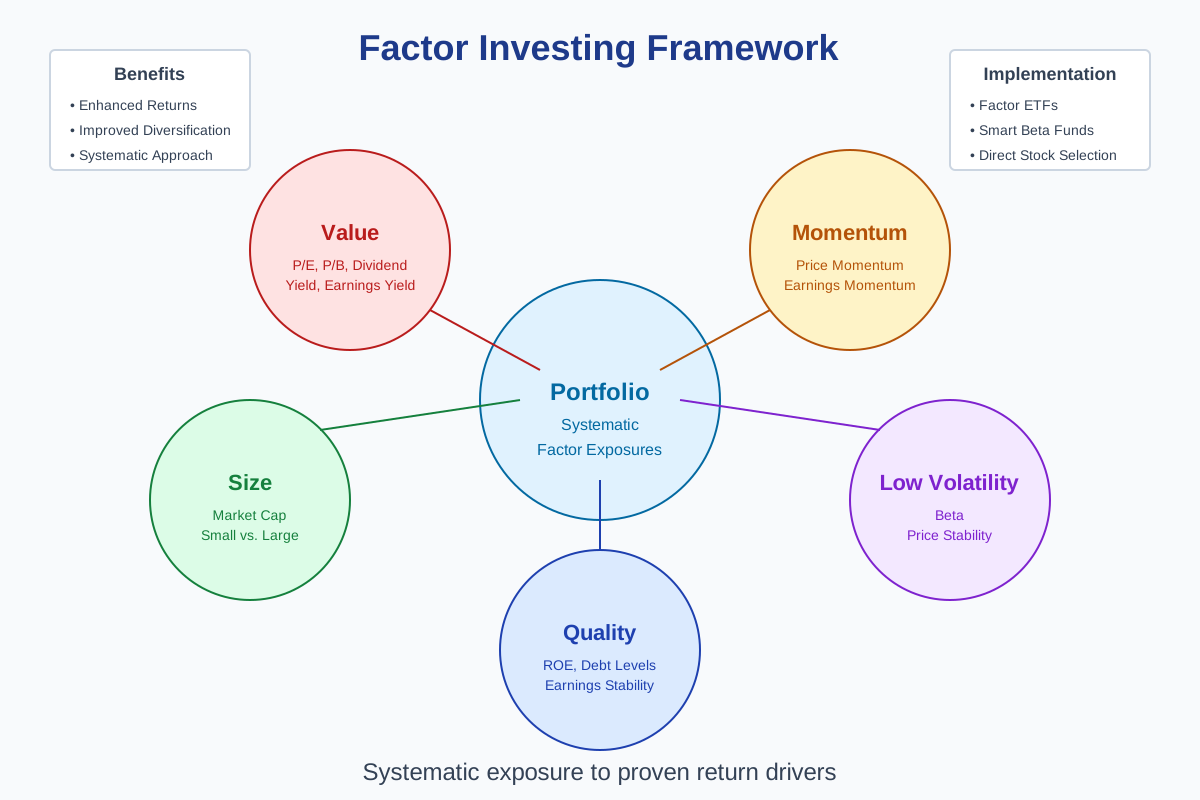
The value premium exists across asset classes, not just in equities. Value strategies seek to buy relatively cheap assets and sell relatively expensive ones based on fundamental metrics like:
- Price-to-book or price-to-earnings in equities
- Real yield differentials in fixed income
- Purchasing power parity deviations in currencies
- Futures curve pricing relative to spot in commodities
2. Momentum
Momentum strategies capitalize on the tendency of recent price trends to continue. Implementation approaches include:
- Time-series momentum: Going long assets with positive recent performance and short those with negative performance
- Cross-sectional momentum: Long the best performers and short the worst performers within an asset class
- Fundamental momentum: Following trends in earnings or economic data rather than just prices
3. Carry
Carry strategies seek to profit from yield differentials between similar assets, essentially getting paid to hold higher-yielding assets. Examples include:
- Currency carry (investing in higher interest rate currencies)
- Commodity roll yield (benefiting from futures curve structures)
- Bond term premia (capturing yield curve differentials)
- Volatility carry (selling options to collect premium)
4. Defensive/Low Volatility
These strategies exploit the anomaly that lower-risk assets often deliver better risk-adjusted returns than higher-risk assets. Implementations include:
- Low-volatility equity portfolios
- Quality-focused strategies across asset classes
- Minimum variance portfolio construction
5. Liquidity Premium
Liquidity strategies harvest the premium paid for providing liquidity to markets or assuming less liquid positions. Examples include:
- Capturing bid-ask spreads in market-making strategies
- Investing in less liquid segments of otherwise liquid markets
- Providing liquidity during periods of market stress
Implementation Approaches
Long/Short Implementation
Many ARP strategies are implemented in a market-neutral, long/short format to isolate the specific premium and reduce exposure to broader market movements. This approach can provide true diversification from traditional market beta but requires the ability to short securities or use derivatives.
Long-Only Tilts
For investors unable to implement short positions, alternative risk premia can still be accessed through long-only portfolios that overweight securities with favorable characteristics. While this approach maintains market exposure, it can enhance returns and improve portfolio characteristics.
Multi-Premia Portfolios
Combining multiple alternative risk premia into a single portfolio offers significant diversification benefits, as different premia often perform well in different market environments. Strategic allocation across various premia can create more stable return streams than focusing on any single alternative risk premium.
Key Benefits of Alternative Risk Premia
Enhanced Diversification
Alternative risk premia typically show low correlation to traditional asset classes and often to each other, providing true portfolio diversification beyond conventional approaches.
Liquidity and Transparency
Unlike many alternative investments, ARP strategies can be implemented in liquid markets with transparent pricing and clear rules-based methodologies.
Cost Efficiency
ARP strategies often deliver alternative-like returns and diversification benefits at lower costs than traditional hedge funds or private investments.
Scalability
Many alternative risk premia can accommodate significant capital without materially impacting returns, making them suitable for institutional portfolios.
Considerations and Challenges
Capacity Constraints
Some alternative risk premia can become crowded as more investors adopt similar strategies. Monitoring strategy capacity and adjusting implementation approaches may be necessary as ARP investing becomes more mainstream.
Implementation Complexity
Effective ARP strategies often require sophisticated execution capabilities, including derivatives trading, short selling, and cross-asset implementation.
Strategy Decay
The effectiveness of alternative risk premia can diminish over time as markets become more efficient or investor behavior changes. Ongoing research and strategy evolution are essential for long-term success.
Conclusion
Alternative risk premia represent a powerful addition to modern portfolio construction, offering systematic return sources with diversification benefits beyond traditional investments. By capturing returns from market inefficiencies and structural biases across asset classes, these strategies can potentially enhance risk-adjusted returns and improve portfolio resilience in various market environments.
Our quantitative analysis tools can help you identify and implement appropriate alternative risk premia strategies aligned with your portfolio objectives and constraints.
Free Trading Math & Risk Cheat Sheet
Every key formula in one PDF: breakeven win rates, expectancy, position sizing, drawdown recovery, volatility drag, VaR and CVaR. Plus occasional emails when we publish new quant tools.