Portfolio Rebalancing Calculator: How Much to Buy, Sell and When
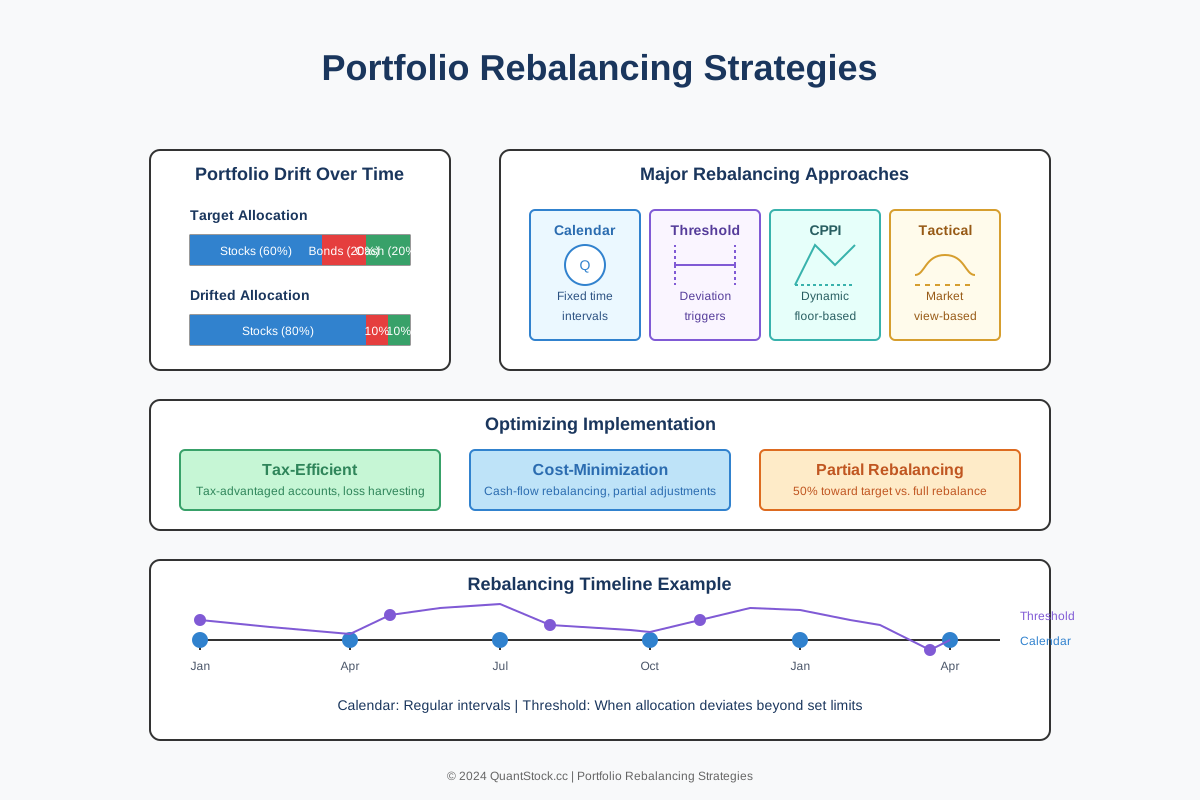
Rebalancing means selling a little of what grew and buying what lagged, so your portfolio keeps the risk you chose. Enter your holdings below to get the exact trades, then read on for the math, how often to rebalance, which threshold to use, and how to keep costs and taxes low.
Rebalancing Calculator
Enter what you hold and your target mix. Get the exact buy and sell amounts.
Rebalance: at least one asset is more than 5 points from its target (largest drift 6.1 points).
| Asset | Now | Target | Drift | Trade |
|---|---|---|---|---|
| Stocks | 66.1% | 60.0% | +6.1 pts | Sell $7,200 |
| Bonds | 33.9% | 40.0% | -6.1 pts | Buy $7,200 |
To get back to target without selling anything, you would need to add about $12,000 of new money, all into the underweight assets.
Drift = current weight − target weight, in percentage points. Before costs and taxes.
Full calculator with costs & taxesHow to Use the Rebalancing Calculator
- List your holdings. Use asset classes or funds, for example US stocks, international stocks and bonds. It works for simple "lazy" portfolios such as a two-fund or three-fund portfolio, and for up to eight positions.
- Enter today's value of each holding and your target percentage. Targets must add up to 100%.
- Set your threshold in percentage points. With 5, the calculator flags any asset more than 5 points away from its target.
- Optional: add new money. If you are about to invest cash, enter it. Tick "Don't sell" to see how to split the new money so that you move back toward target without selling anything.
The result shows each asset's current weight, its drift from target, and the exact dollar amount to buy or sell. The default example is the 60/40 portfolio from the worked example further down. For trading costs and an estimate of capital gains tax, use the full portfolio rebalancing calculator.
How to Calculate Portfolio Drift
Drift is the gap between where your portfolio is and where you want it to be. Four short formulas cover everything the calculator does:
- Current weight of asset i: wi = valuei / total portfolio value
- Absolute drift (percentage points): di = wi − targeti
- Relative drift: di / targeti. A 5% asset that grows to 7.5% has drifted only 2.5 points, but 50% in relative terms.
- Trade to restore target: targeti × total value − valuei. A positive number means buy, a negative number means sell.
One more useful number is total drift: half the sum of all absolute drifts, ½ × Σ|di|. It equals the share of the portfolio you must move to get back on target. If total drift is 6.1%, you need to sell 6.1% of the portfolio and buy the same amount elsewhere.
Worked Example: Rebalancing a 60/40 Portfolio
You invest $100,000: $60,000 in a stock fund and $40,000 in a bond fund. Over the next period stocks rise 30% and bonds are flat.
| Asset | Value now | Weight now | Target | Drift | Trade |
|---|---|---|---|---|---|
| Stocks | $78,000 | 66.1% | 60% | +6.1 pts | Sell $7,200 |
| Bonds | $40,000 | 33.9% | 40% | −6.1 pts | Buy $7,200 |
| Total | $118,000 | 100% | 100% |
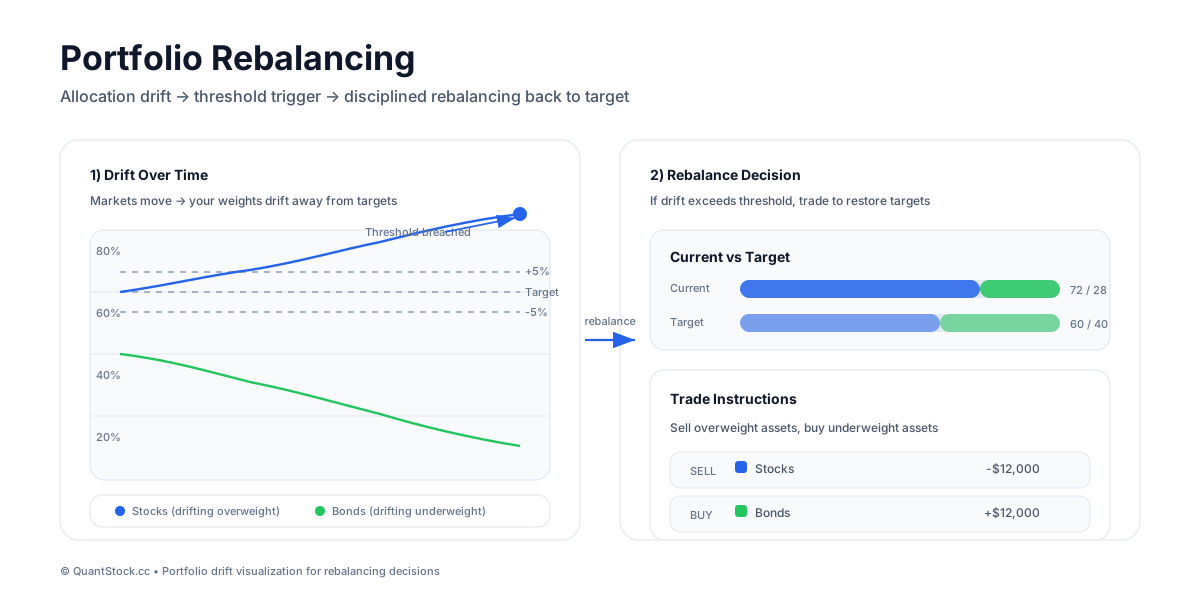
The stock weight is now 66.1%, 6.1 points above target (10.2% in relative terms), which breaks a 5-point threshold. To restore 60/40 you need stocks at 60% × $118,000 = $70,800, so you sell $7,200 of stocks and buy $7,200 of bonds.
Tax cost in a taxable account. The stock fund cost $60,000 and is worth $78,000, so 23.1% of every dollar you sell is gain. Selling $7,200 realizes about $1,662 of gain. At a 15% long-term capital gains rate that is roughly $249 of tax; at 20% it is about $332. In a tax-advantaged account such as an IRA or 401(k) the same trade costs no tax.
Rebalancing without selling. If you add new money instead, putting $12,000 into bonds brings the portfolio to $130,000 with stocks at exactly 60%. Smaller amounts move you part of the way. Enter the new money in the calculator above and tick "Don't sell" to see the split.
How big a market move triggers a rebalance? For a 60/40 portfolio to reach 65/35, stocks have to beat bonds by about 23.8% (relative return). To reach 70/30 they have to beat bonds by about 55.6%. That is why a 5-point band on a 60/40 portfolio typically triggers only after a strong year for one asset class or a sharp crash.
How Often Should You Rebalance Your Portfolio?
The most cited study on this question is Vanguard's Best Practices for Portfolio Rebalancing (Jaconetti, Kinniry and Zilbering, 2010). The authors tested a 60% stock / 40% bond portfolio from 1926 to 2009 and found no single optimal frequency or threshold. What changed between rules was mainly how often you trade, not how much risk you take:
- Rebalanced monthly: 8.5% average annualized return, 12.1% volatility.
- Rebalanced annually: 8.6% return, 11.9% volatility, with far fewer trades.
- Never rebalanced: 9.1% return but 14.4% volatility, because the stock share drifted to more than 84% on average. That is a different, riskier portfolio than the one the investor chose.
- Monitoring monthly with a 1% threshold led to 389 rebalancing events over the period; monitoring annually with a 10% threshold led to only 15.
Their practical conclusion: for most diversified stock and bond portfolios, check once or twice a year and rebalance when an asset is more than about 5 percentage points from target. Annual reviews make most sense when taxes or trading costs are significant. The point of rebalancing is to keep risk where you set it, not to boost returns.
A second line of research looks at checking more often but trading less. Daryanani (2008) found that looking at the portfolio frequently (every two weeks in his study) and trading only when an asset breaks a fairly wide band captured more of the benefit of rebalancing than a fixed once-a-year date. That approach suits people with automated tools or the habit of checking often.
| Approach | How it works | Best for | Watch out for |
|---|---|---|---|
| Calendar | Rebalance on a fixed date, e.g. every January | Simplicity, tax-advantaged accounts | Trades even when drift is tiny; ignores big moves between dates |
| Threshold | Rebalance only when an asset breaks its band | Keeping risk tight with few trades | Needs regular checking |
| Calendar + threshold | Check on a schedule, trade only if the band is broken | Most investors (Vanguard's suggestion) | Pick the band before you need it |
| Cash flow | Send new money, dividends or withdrawals to the right assets | Investors adding or withdrawing regularly | Too slow after a large market move |
For a deeper comparison of monthly, quarterly and annual schedules, read our analysis of optimal rebalancing frequency and our overview of portfolio rebalancing strategies.
Choosing a Rebalancing Threshold
A threshold in percentage points (absolute) works well for large holdings. A 5-point band around a 60% stock target means you act below 55% or above 65%.
For small holdings, a fixed 5-point band is too loose. A 5% gold or REIT position could triple to 15% before it triggers. That is why many investors add a relative band for small positions: rebalance when an asset moves more than about 25% away from its own target. For a 10% target that means acting outside 7.5% to 12.5%.
A simple rule that covers both cases: use 5 points for holdings of 20% or more, and a 25% relative band for smaller ones. Use a tighter band if you trade inside a tax-advantaged account for free; use a wider one when every sale triggers tax.
Rebalancing Costs and Taxes
Every rebalance has three possible costs:
- Commissions. Many brokers now charge nothing for stock and ETF trades, but some mutual funds and international markets still carry fees.
- Bid-ask spreads. Small for large ETFs, wider for thinly traded funds and individual bonds.
- Taxes. Selling a winner in a taxable account realizes a capital gain. In the US, long-term gains are taxed at 0%, 15% or 20% depending on income (short-term gains at ordinary income rates). Other countries have their own rules.
To keep these costs low, use the cheapest tools first:
- Direct new contributions and dividends to underweight assets.
- When you need to withdraw, sell from the overweight assets.
- Make the sell-and-buy trades inside tax-advantaged accounts (IRA, 401(k), or your country's equivalent) where gains are not taxed.
- In taxable accounts, sell positions with losses or small gains first, and prefer long-term holdings over short-term ones.
Look at your allocation across all accounts combined, then decide where to place the trades. The full rebalancing calculator adds trading costs and an estimate of the tax on the sales.
Common Rebalancing Mistakes
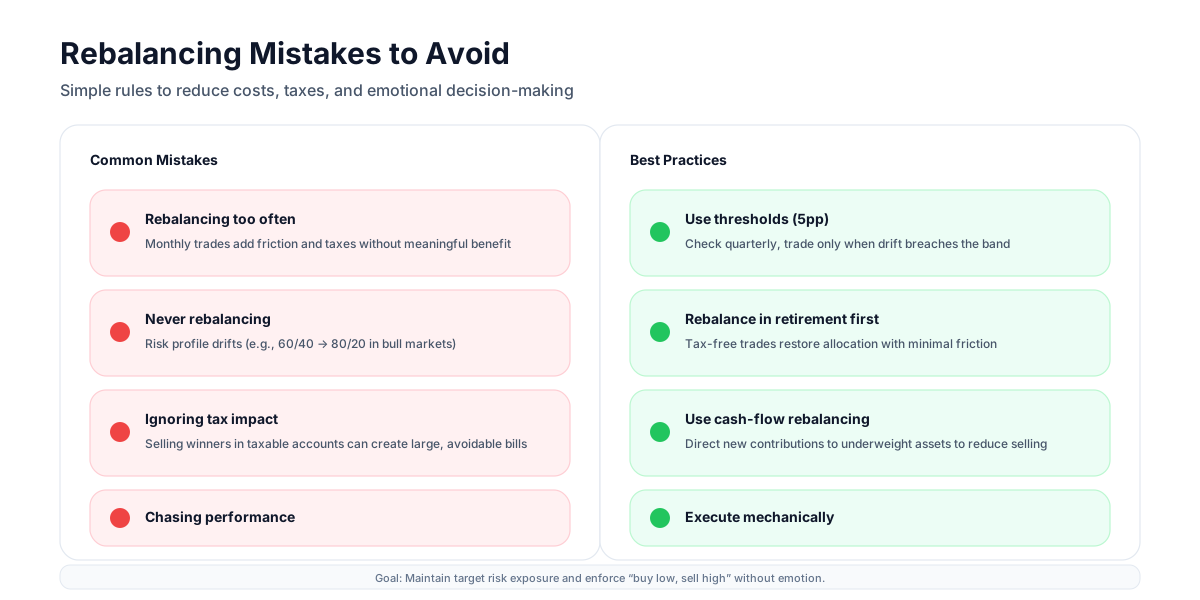
- Never rebalancing. As the Vanguard data shows, a 60/40 portfolio left alone ended up with more than 80% in stocks on average, with volatility of 14.4% instead of about 12%.
- Rebalancing too often. Monthly trading adds costs and taxes without a meaningful reduction in risk.
- Ignoring taxes. In a taxable account, a slightly wider band is often cheaper than paying tax on every small trade.
- Waiting for the "right moment". Rebalancing is a rule, not a market call. Decide the rule in advance and follow it, especially after a crash, when buying the asset that just fell feels hardest.
- Over-precision on small accounts. On a $5,000 portfolio, a 3-point drift is $150. Fix it with your next contribution instead of trading.
Frequently Asked Questions
How often should I rebalance my portfolio?
For most investors, checking once or twice a year and rebalancing only when an asset is more than about 5 percentage points from target is enough. Vanguard's study of a 60/40 portfolio from 1926 to 2009 found that monthly, quarterly and annual rebalancing gave very similar risk and return, while monthly rebalancing needed far more trades.
What is a good rebalancing threshold?
5 percentage points is a common choice for large holdings. For small positions (under about 20% of the portfolio), use a relative band of around 25% of the target, for example 7.5% to 12.5% for a 10% holding. Use wider bands in taxable accounts where each sale creates tax.
How do I calculate portfolio drift?
Divide each holding's value by the total to get its current weight, then subtract the target weight. A stock fund worth $78,000 in a $118,000 portfolio weighs 66.1%; against a 60% target the drift is +6.1 percentage points. The trade needed is the target weight times the total value minus the current value.
Does rebalancing increase returns?
Not reliably. Its main job is risk control. In Vanguard's data, a 60/40 portfolio that was never rebalanced earned more on average (9.1% versus 8.6% a year) because it drifted to more than 80% stocks, but its volatility was 14.4% instead of 11.9%. Rebalancing keeps you in the portfolio you actually chose.
Should I rebalance after a market crash?
If the crash pushes an asset outside your band, yes: follow the rule you set. After a large stock decline, rebalancing means buying stocks while they are down, which is uncomfortable but is exactly what the rule is for. Using new contributions first can reduce how much you need to sell.
Can I rebalance without selling?
Yes, by directing new money, dividends and interest to the underweight assets (cash-flow rebalancing). In the 60/40 example, adding $12,000 to bonds restores the target with no sale. The calculator above shows how much new money you would need and how to split it.
Related Tools and Guides
- Portfolio rebalancing calculator: the full version with trading costs and capital gains tax.
- Portfolio optimizer: choose the target allocation in the first place, using the efficient frontier or CVaR.
- Volatility drag calculator: see how swings in return reduce long-term growth.
- Drawdown recovery calculator: how much a portfolio must gain to recover from a loss.
- Sequence of returns risk calculator: why the order of returns matters when you withdraw.
- Optimal rebalancing frequency and rebalancing strategies compared.
Sources
- Jaconetti, C. M., Kinniry, F. M. and Zilbering, Y. (2010). Best Practices for Portfolio Rebalancing. Vanguard Research. Summarized in the AAII Journal (2011).
- Daryanani, G. (2008). Opportunistic Rebalancing: A New Paradigm for Wealth Managers. Journal of Financial Planning, January 2008.
- U.S. Securities and Exchange Commission, Investor.gov: Rebalancing.
- Internal Revenue Service: Topic no. 409, Capital gains and losses.
This guide and calculator are for education only and are not investment or tax advice. Past results do not guarantee future returns. Check the tax rules that apply to you. See our disclaimer.
Free Trading Math & Risk Cheat Sheet
Every key formula in one PDF: breakeven win rates, expectancy, position sizing, drawdown recovery, volatility drag, VaR and CVaR. Plus occasional emails when we publish new quant tools.